# Power Bank Capacity: Compare Cell mAh, Rated Output and Wh Before Buying
Comparing different capacity definitions can distort a wholesale purchase. Separate cell mAh, rated output capacity and Wh, and calculate only from the voltage stated for that capacity.
- URL: https://nexussupplytech.com/blog/power-bank-capacity-wholesale-checks
- Category: Wholesale
- Date: 2026-10-09
- Author: Jack Lau
- Read time: 9 min read
- Tags: Power Bank Capacity, Specification Checks, Wholesale Samples
- Related solution: [Compare Wholesale Phone Accessories](https://nexussupplytech.com/phone-accessories-wholesale)
Comparing a cell-capacity figure with an output-capacity figure can lead to a misleading purchase decision. Compare power bank capacity using its definition and voltage: **Wh = Ah × V**, with mAh converted to Ah before multiplication.
For a wholesale sample, keep internal cell charge capacity, stated energy and rated output capacity in separate fields. This guide provides a comparison record, not a capacity test or a ranking of products. The [phone accessories wholesale range](/phone-accessories-wholesale) provides the commercial starting point; the tables below explain what to request before comparing its candidate lines.
## Key Takeaways
- Capacity comparisons need a definition and a matching voltage basis.
- Keep battery energy and rated output conditions in separate fields.
- Leave missing inputs blank and distinguish ratings from sample observations.
**Takeaway:** Leave missing inputs blank and distinguish ratings from sample observations.
## Quick specs: collect the capacity basis
Collect the definition behind each capacity number before deciding which offer provides more usable energy. A large mAh figure without its voltage and capacity basis is an incomplete input.
| Input or item | Typical value or source | Why it matters |
| --- | --- | --- |
| Exact SKU and revision | Quotation, unit identity and specification | Connects the figures to one candidate |
| Cell or battery capacity, mAh | Specification naming the capacity basis | Identifies the charge-capacity declaration |
| Nominal voltage for that capacity, V | Same battery specification | Supplies the voltage for the energy calculation |
| Stated battery energy, Wh | Unit marking or specification | Allows a consistency check on the stated basis |
| Rated output capacity and voltage | Product specification with output conditions | Defines a separate output-energy comparison |
| Output conditions | Port, load and other declared rating conditions | Prevents comparison across different operating conditions |
| Sample evidence | Unit photos and any agreed test record | Separates a printed rating from an observed result |
Request these fields when reviewing the [power banks wholesale options](/power-banks-wholesale). If an item is missing, mark it “not supplied” and ask for it. An empty voltage cell is not permission to insert a familiar nominal voltage from another product.
For a power bank included in a retail kit, carry these same capacity fields into the [store-ready phone and accessories bundle record](/blog/store-ready-phone-accessories-bundles). Keep cable and source requirements distinct from the stored-energy calculation; a charging configuration does not determine the missing battery voltage.
**Takeaway:** The capacity definition and its matching voltage come before the comparison.
## Separate cell charge, energy and output capacity
Cell mAh describes charge capacity on the stated battery basis; Wh expresses energy on that basis. Rated output capacity describes a separate product rating under stated output conditions.
A power bank's conversion stage changes the relationship between internal battery charge and charge delivered at its output voltage. Conversion losses can also affect output energy. Therefore an output mAh figure can be lower than the cell mAh figure without those two declarations contradicting each other.
| Declaration | How to read it | Procurement question |
| --- | --- | --- |
| Cell or battery mAh | Charge capacity at the matching nominal voltage | Which capacity definition and voltage does the specification use? |
| Battery Wh | Stated energy for the battery basis | Is it consistent with the stated charge capacity and voltage? |
| Rated output mAh | Declared output charge under specified conditions | At which output voltage, port and load was it rated? |
| Output wattage, W | A power rating, rather than a stored-energy quantity | Is this field being mistaken for capacity? |
Keep the unit identity, label information and specification together; enter the actual figures in the capacity record.
If a quote mixes these terms, request a corrected field description before comparing its price. The [wholesale quote comparison guide](/blog/how-to-compare-wholesale-phone-quotes) covers the wider requirement to compare the same order scope. Here, the specific issue is which capacity quantity the quote is describing.
**Common mistake:** Treating a smaller output mAh figure as evidence of a deficient battery without checking the two voltage bases.
**Takeaway:** Compare charge with charge on the same basis, or convert to energy using the matching stated voltage.
## Calculate only when the voltage basis is known
Use the charge-capacity value and voltage that describe the same battery basis. The unit conversion is:
**Ah = mAh ÷ 1,000**
**Battery energy, Wh = (battery capacity, mAh ÷ 1,000) × matching nominal voltage, V**
The same dimensional relationship can express a stated output rating as energy:
**Rated output energy, Wh = (rated output capacity, mAh ÷ 1,000) × stated output voltage, V**
Use the output formula only for capacity declared at one fixed output voltage under the same rating conditions. If a specification lists several voltage profiles without an output capacity tied to one profile, leave output Wh blank. A port rating in amperes, A, is current; it cannot be used as the charge-capacity input in Ah. Variable-voltage discharge needs an appropriate energy record rather than multiplication by a chosen maximum voltage. This calculation interprets a supplied rating, with its conditions preserved.
| Calculation field | Entry for the actual candidate | Rule for this record |
| --- | --- | --- |
| Battery capacity, mAh | Leave blank until supplied | Keep the source's capacity definition |
| Matching nominal voltage, V | Leave blank until supplied | Do not borrow another SKU's voltage |
| Calculated battery energy, Wh | Leave blank until both inputs are supplied | Apply the formula on the same basis |
| Printed battery energy, Wh | Leave blank until photographed or documented | Compare the declaration with the calculated result |
| Fixed output voltage, V | Leave blank until supplied for the rated output capacity | Do not select a voltage from an unrelated output profile |
| Rated output capacity, mAh | Leave blank until supplied | Record the output voltage and conditions alongside it |
| Calculated rated output energy, Wh | Leave blank until the required output inputs are supplied | Preserve the declared conditions |
No SKU figures have been supplied for this record, so there is no numerical product example to calculate. A missing field remains blank, rather than becoming zero or an assumed value. If a supplied Wh marking and the calculation disagree, check the identity, capacity definition and voltage with the supplier before deciding why they differ.
**Takeaway:** Calculate from matched inputs, and keep both the calculated figure and the printed declaration visible.
## Compare two quotations without guessing missing inputs
Use one row definition for both candidates. If the suppliers provide different capacity bases, the useful next step is a clarification request rather than a winner.
| Comparison field | Candidate A | Candidate B | Evidence to attach |
| --- | --- | --- | --- |
| Exact SKU and revision | Not supplied | Not supplied | Quotation and specification reference |
| Battery capacity definition | Not supplied | Not supplied | Supplier's explicit description |
| Battery charge capacity, mAh | Not supplied | Not supplied | Capacity declaration |
| Matching nominal voltage, V | Not supplied | Not supplied | Battery specification |
| Declared battery energy, Wh | Not supplied | Not supplied | Unit marking or specification |
| Calculated battery energy, Wh | Not calculated | Not calculated | Matching battery mAh and nominal V |
| Rated output capacity, mAh | Not supplied | Not supplied | Output capacity declaration |
| Matching fixed output voltage, V | Not supplied | Not supplied | Same output rating conditions |
| Calculated rated output energy, Wh | Not calculated | Not calculated | Matched output mAh and fixed V |
| Port and rating conditions | Not supplied | Not supplied | Conditions attached to the output rating |
| Agreed sample observation | No record supplied | No record supplied | Identified sample and agreed method |
The letters identify two offers you are considering; they do not stand for actual NexusSupply products. Once the cells are populated, distinguish “battery energy comparable” from “output conditions comparable.” The first does not automatically establish the second.
For a missing output rating, ask the supplier to identify whether one is available for the named SKU. Do not derive usable capacity from battery Wh using an assumed efficiency. Nor should a printed output rating be presented as a test you performed.
Use the [mixed-SKU order planning guide](/blog/mixed-sku-wholesale-order-planning) to attach this record to each power-bank line. It prevents the figures for one model or revision from being reused for a visually similar substitute. The [supplier verification checklist](/blog/verify-mobile-phone-supplier-china) helps resolve document and quotation identity when the references differ.
Paste the candidate reference, capacity fields and missing-field questions into the inquiry message. Include references or links to the specification and label photographs in the message; the form has no attachment upload.
Use a missing-field record to close the comparison. “Question sent” remains open until a reply supplies the required information or the buyer records an accepted exception.
| Missing field and candidate | Confirmation owner / contact | Reply and evidence reference | Open / closed / accepted exception | Buyer decision / date |
| --- | --- | --- | --- | --- |
| Buyer to enter | Buyer to enter | Leave blank until received | Open | Leave blank until decided |
**Takeaway:** Close missing definitions and conditions before comparing candidates on delivered energy.
## Tie rated output to the sample record
A unit label establishes a declaration, while an agreed discharge record establishes an observation under its recorded conditions. Preserve that distinction when qualifying a sample.
For a capacity observation, agree the method before the review. Record the sample identity, starting state, output port, voltage, load, stopping criterion and instrument record. Ask which conditions are needed to compare the observation with the manufacturer's output rating. These are proposed record fields, not a claim that NexusSupply runs a specified laboratory test.
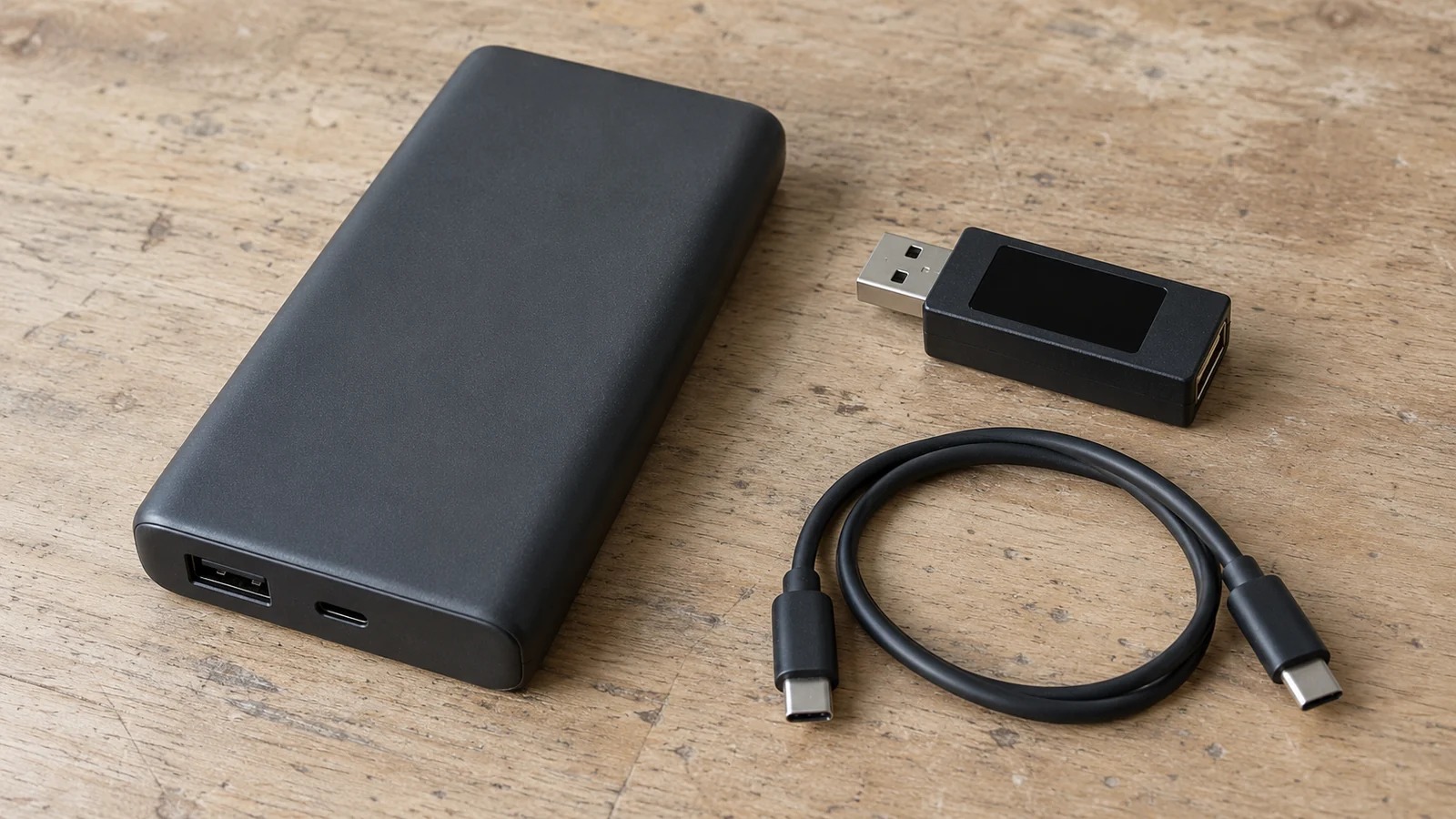
Example equipment for preparing an output review. No reading or discharge result is shown.
| Sample-record question | Evidence to request | Decision owner |
| --- | --- | --- |
| Is this the quoted SKU and revision? | Order or quote reference, unit identity and specification version/date | Buyer and supplier reconcile the reference |
| Which physical sample was reviewed? | Sample identifier and available batch or carton-position reference | Buyer records a missing identifier as an open question |
| Who issued the evidence, and when? | Evidence issuer, observation date and record reference | Buyer links the evidence to the sample |
| Which capacity declaration is being checked? | Exact label wording and voltage basis | Buyer defines the acceptance question |
| Are output conditions comparable? | Port, voltage, load and agreed method | Buyer reviews the documented conditions |
| Is there an observed result? | Identified sample record and instrument evidence, if agreed | Buyer evaluates the supplied evidence |
| Does a difference remain unresolved? | Written supplier clarification and buyer decision | Buyer records whether to proceed or hold |
For later batch acceptance, use the existing [charger and power-bank wholesale QC checklist](/blog/phone-charger-power-bank-wholesale-qc-checklist). Use the capacity record to clarify definitions before ordering, and the QC checklist to accept a later batch against that written order.
If charging equipment is included in the request, record it separately using the [phone charger category](/phone-chargers-wholesale). Neither charger wattage nor a successful charging indication supplies the missing capacity evidence.
**Takeaway:** Keep label ratings and sample observations in separate fields, tied to the same product identity.
## Carry the accepted basis into the order
Preserve the accepted capacity definition when the sample becomes an order line. Replenishment is easier to check when the quote, specification, unit markings and agreed exceptions point to the same reference.
Keep capacity declarations attached to each sample and order line, including any approved change of revision.
If a supplier proposes a substitute, request the same battery and output fields again. A matching headline mAh figure is only one attribute. Record any missing output conditions or difference in the declared basis as an open question until the buyer decides whether the alternative meets the requirement.
**Common mistake:** Carrying an output figure from the approved sample into a substitute's order line because the two headline capacities match.
**Takeaway:** Repeat the capacity-basis check for a changed model or revision.
## When this does not apply
These formulas convert documented charge and voltage into an energy figure. They do not estimate a phone's number of full charges, battery life, real conversion efficiency, wireless transfer losses or time between recharges. Those outcomes need their own equipment and usage conditions.
A single factory example's voltage or efficiency is not a default for every power bank. Transport acceptance and destination compliance are separate reviews; a calculated Wh value does not establish permission to ship or carry a product. This guide also leaves physical inspection and electrical safety testing to the agreed product-specific process.
**Takeaway:** Use the comparison record for capacity interpretation, and request separate evidence for performance or compliance questions.
## Method and sources
The capacity comparison uses Wh = Ah × V on a stated battery basis and applies the same relationship to output capacity declared at a fixed voltage. A supplier's rating is a declaration; an identified sample record is an observation under its own conditions.
The blank comparison and sample tables are procurement suggestions. They contain no measured SKU results. The photos show example objects and record arrangements, rather than readable capacity labels or proof of performance.
**Takeaway:** Preserve the capacity definition, voltage basis and evidence type with every result.
## Why is the rated capacity marked on a power bank lower than expected?
Usually because the smaller figure is the rated output capacity at the output voltage, while the larger one describes the internal battery. The internal mAh declaration and the rated output mAh declaration can have different bases, with conversion loss affecting the relationship. Resolve those definitions before judging the item.
**Takeaway:** Ask what each capacity figure measures before comparing the numbers.
## Should I buy a 10000mAh or 20000mAh power bank?
It depends on the retail use; those numbers alone cannot select a wholesale line. Compare the declared voltage basis, rated output conditions, required equipment and retail format. Choose using the documented requirement and evidence for the actual candidates.
**Takeaway:** Treat headline capacity as an input, rather than a complete buying decision.
## Is a 20k powerbank overkill?
It can be for some retail uses. Decide from the intended use and the candidate's actual specification. Ask for physical size, weight, output details and the relevant capacity basis instead of assuming that a larger headline capacity fits every shelf or bundle.
**Takeaway:** Check the whole order requirement before increasing the capacity tier.
## How long does a 20000mAh power bank last?
There is no single answer: a headline mAh figure alone does not determine operating time or the number of phone charges. Record the device, use and output conditions, and request a suitable test record if endurance is part of the purchase requirement.
**Takeaway:** Keep any endurance claim conditional on a documented use and method.
## Which power banks have PPS charging?
Only models whose own specification declares PPS support. Check the exact candidate's protocol and port specification. A capacity figure does not establish PPS support, and support declared for one model does not extend automatically to another.
**Takeaway:** Keep protocol support separate from the capacity fields.
## Where can I buy wholesale power banks?
Start with the standard power-bank category, then submit the candidate identity, required capacity basis, output needs and quantity through the wholesale inquiry. Confirm the specific quotation and availability before ordering.
**Takeaway:** Request a quote against defined fields, with missing evidence identified.
## RFQ Fields
- SKU, revision and required quantity
- Unit-label photographs and matching specification
- Battery charge capacity, its definition and matching nominal voltage
- Printed Wh and any same-basis calculation
- Rated output capacity, output voltage, port and load conditions
- Missing fields that need supplier clarification
- Intended devices and any agreed sample method or existing record
- Packaging requirements and approval conditions for substitutions
Paste the capacity fields and evidence references into the [capacity-focused wholesale inquiry](/rfq) message. Keep values that have not been supplied blank and identify who needs to confirm them.
**Takeaway:** A capacity comparison is ready for purchase only when its definitions and open questions are explicit.