
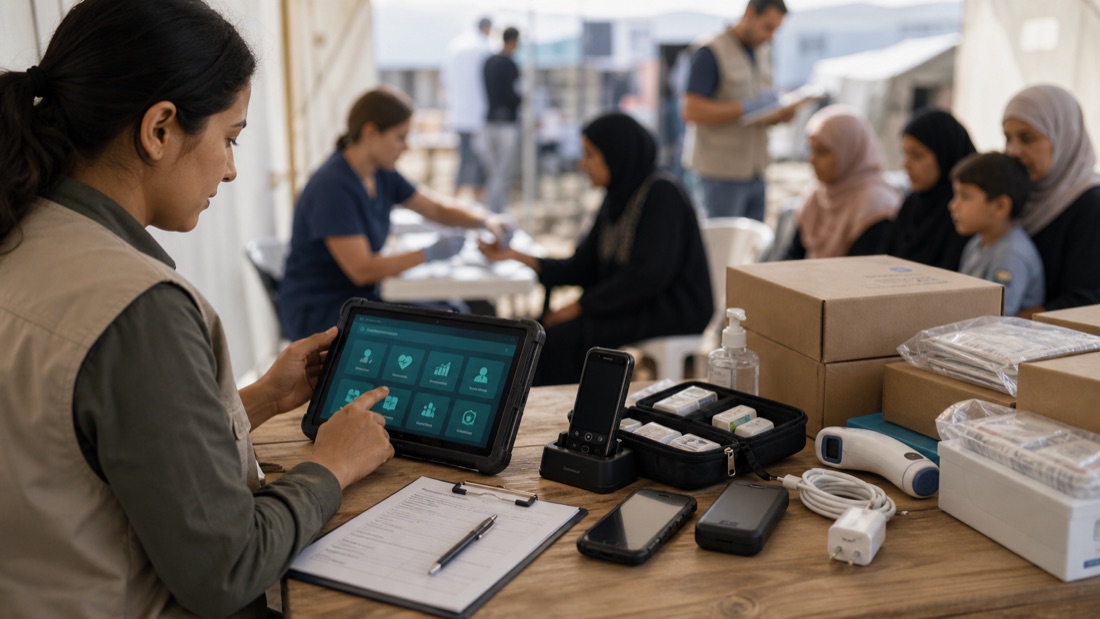
An NGO or public-health program may depend on forms, outreach, training or logistics, but those activities do not belong in a supplier’s service scope. The buyer first separates its clinical, data and safeguarding controls from the standard hardware kit it wants to purchase. NexusSupply supplies devices and accessories only.
The standard Android hardware RFQ checklist provides the shared catalog, version, quantity, evidence and handoff fields. This guide begins with the program boundary, then builds a kit that can be tested, counted and quoted without sharing live program data.
Key Takeaways
- Define the buyer-owned clinical, privacy and data controls before preparing the supplier request.
- Build the device and accessory kit around the actual field routine and charging conditions.
- Test the exact regional version with synthetic records before approving bulk hardware.
- Plan how each kit will be labeled and reconciled at carton level.
- Put kit quantities, QC evidence and the mainland China or Hong Kong handoff in the RFQ.
Separate program controls from the hardware order
The buyer’s approved software, privacy and compliance teams own the apps, forms, content, accounts, encryption, data retention, MDM enrollment, remote lock or wipe and safeguarding controls. Clinical decisions, app deployment, data governance and program operations also remain with the buyer or its appointed third party.
NexusSupply does not provide custom Android, app preload, MDM, Private Label, clinical software or managed-device services. The supplier request should describe only the standard catalog hardware, accessories, quantities, evidence and handoff.
Build the kit around the field routine
Document whether the device will be used indoors or outdoors, the expected shift length, screen and charging conditions, camera or GPS use and periods away from a network. These details can narrow an Android tablets wholesale shortlist, but the final request needs measurable hardware fields.
For offline work, the buyer’s technical team should estimate storage and battery needs through its own software test. If the device will capture photos or location, specify the camera and GPS hardware required. Ask for evidence when dust, moisture or drop requirements apply to the exact model. A general “field tablet” label is not enough.
Hardware brief
- Phone or tablet category
- Screen, memory, storage and battery range
- Camera, GPS, NFC, SIM or other required functions
- Required charger plug and charging options
- Case, screen protector, power bank or other accessory compatibility
Test the exact sample with synthetic records
Before approving bulk hardware, the buyer or its appointed provider should test its software and management profile on the exact sample. Use synthetic records and test credentials, not patient, beneficiary or staff data. Keep the device version, Android build, buyer-owned profile revision and acceptance result in the buyer’s own file.
Where available, record the manufacturer model code with RAM, storage, color, regional version, SIM arrangement, required languages, Google certification status, charger and retail-box contents. The Android regional-version guide explains what evidence to request when “global version” is too vague.
Ask the relevant carrier, authority or manufacturer to confirm carrier compatibility, local product requirements and warranty eligibility. Health or humanitarian use does not replace those destination-market checks.
Plan how each kit will be counted
A physical kit may contain a device, case, screen protector, charger, cable and power bank. Give each component its own order line and tie it to the exact device model. On the sample, check port access, camera clearance, case fit, connector type, charger rating and any power-bank interface.
Decide how the buyer will reconcile components before setting the packing request. Kit codes, carton labels and a packing list can support counting without opening every carton. The buyer sets spare ratios, distribution, storage and replacement rules. The RFQ contains only the device and accessory quantities to quote.
Physical kit checks
- Exact device and regional version
- Case, screen protector and port fit
- Charger, cable and power-bank compatibility
- Component quantity by kit or order line
- Requested carton labels and packing-list separation
Approve order evidence without sharing program data
Ask for evidence that fits each hardware or packing claim. Depending on the order, this may include box labels, sampled device-information screens, quantity photographs, accessory labels, carton labels and packing-list reconciliation. The mobile phone wholesale QC checklist explains when a photo, continuous video, record or physical inspection is appropriate. Record the agreed evidence scope and availability in this RFQ.
Keep live personal data, app credentials and enrollment tokens out of the evidence request. The buyer-run software test and the supplier’s order evidence belong in separate records.
Write the commercial handoff into the kit schedule
For new Android phones and tablets, the starting point is 10 units without a per-SKU minimum. The starting point for every accessory SKU is 20 units. Multiple SKUs can be combined, and the total order value must exceed US$2,000.
The schedule should name either the buyer’s nominated address in mainland China or Hong Kong, or buyer-arranged UPS/DHL pickup. NexusSupply’s scope does not include FOB, DDP or onward export services.
Evidence and standards
The World Health Organization’s Digital Implementation Investment Guide offers a needs-based planning framework for digital-health programs. Google’s Android device setup guide describes management options a buyer or its provider may evaluate. Neither source makes NexusSupply a software, clinical or data processor. Neither proves that a particular catalog device is suitable for a program. The buyer must validate the exact hardware and its own controls.
Send the final kit schedule
Send the device lines, kit components and carton-separation request through the NexusSupply RFQ form. Add the exact version or acceptable range, quantities, requested QC evidence and selected mainland China or Hong Kong handoff. Expect a response within one business day after submitting a clear RFQ.
RFQ Fields
- Field routine and phone or tablet category
- Accepted model range and required regional version
- Memory, storage, color, charger and box contents for the approved device
- Device and component quantities for each kit
- Requested QC evidence, kit labels and packing-list separation
- Buyer-selected delivery address in mainland China or Hong Kong, or buyer-arranged UPS/DHL pickup