
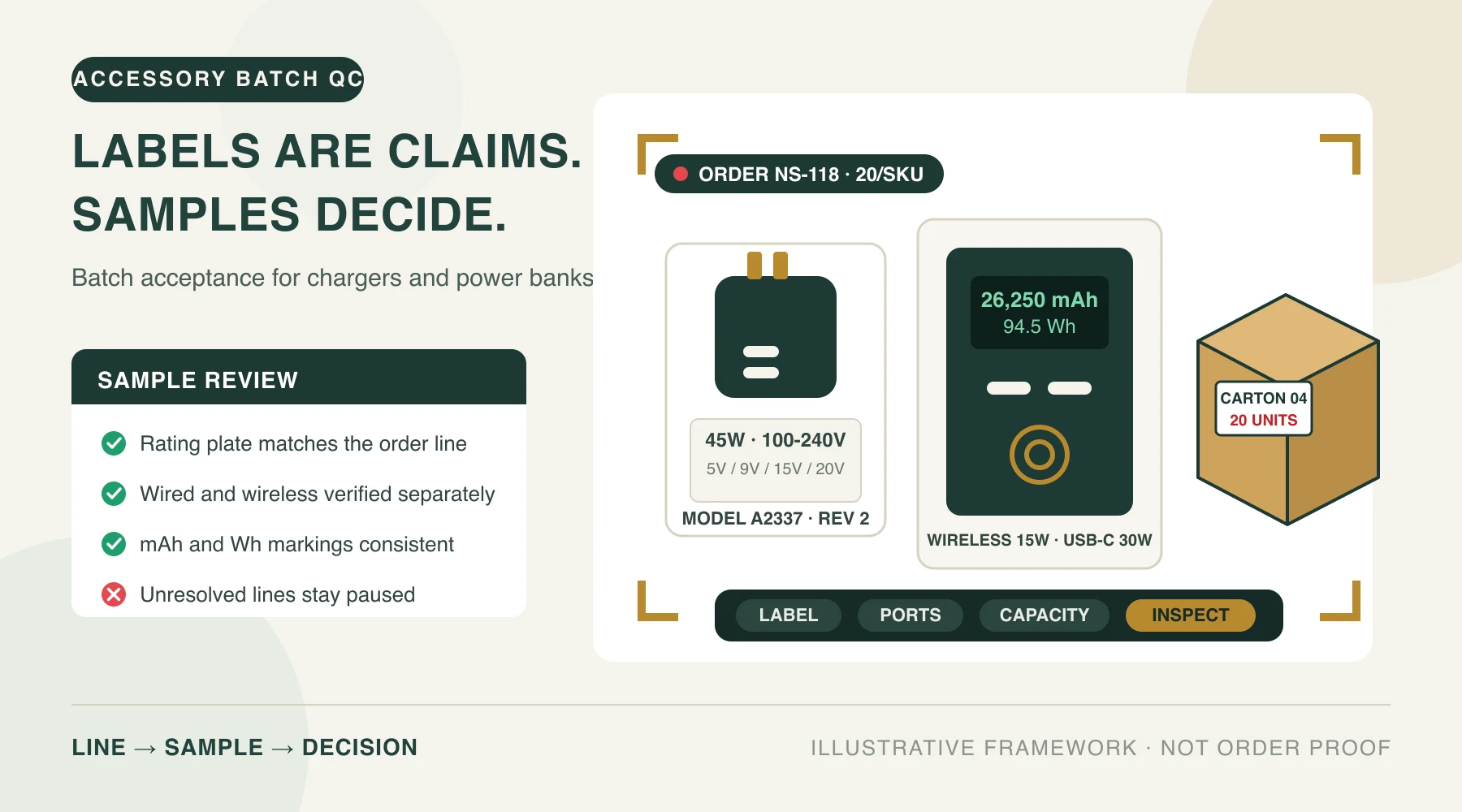
A charger or power bank is accepted on paper long before it is accepted in a carton. The order line should already fix the brand, exact model number, rated output, capacity, port mix, plug type, box language and quantity. This charger and power bank wholesale QC checklist then has one job: confirm that the sampled units, retail boxes and cartons match that line, and record the result before the next payment step.
This checklist covers standalone accessory orders and the accessory lines of a mixed order. Assortment design is a different task: which wattages, capacities and bundles a store should stock is covered in the store-ready phone and accessories bundle guide. For phone or tablet lines in the same order, use the companion mobile phone wholesale quality-control checklist, which owns device identity, software and evidence-type rules.
Catalog context for the checks below sits on the phone chargers wholesale route and the power banks wholesale route; both list Anker charging SKUs with the rated figures this guide keeps referring back to.
This is a procurement-risk framework. It is not legal, customs, banking, carrier or import advice.
Who this accessory checklist is for
This guide is for accessory buyers who ordered by specification: a wholesaler adding chargers to a phone order, a phone shop reordering power banks for a travel season, an ecommerce seller accepting a first 20-unit line. It assumes the order names an exact model and rated figures, not “45W charger” or “10000mAh power bank” in general.
It is written for remote acceptance: photos, video, records and an agreed sampled unit, reviewed before payment or pickup. It does not assume a factory visit or a third-party inspection. Third-party inspection remains an option a buyer can arrange, not a default step in this checklist.
Key Takeaways
- Accept against the order line, not the product family. The exact model number, rated output, capacity and plug type are the baseline; “same series” is not a match.
- A label photo proves what the label says. Rated wattage, real capacity and wireless output need the label, the marking on the unit and an agreed sample test to line up.
- Wired and wireless outputs are separate claims. A Qi2 magnetic power bank has a wireless rating and a USB-C rating; verify each one on its own.
- Sampling on a 20-unit accessory line is a decision, not a percentage rule. Agree in writing which units are opened, tested and photographed.
- Packaging is part of the product. Retail display packs, sleeve language, plug adapters and included cables belong on the order line and in the QC record.
- Close every check with the same three-status close-out used across these QC guides: matches, accepted exception, or unresolved — recorded in the order record, not in chat.
Fix the order baseline before checking any unit
Batch QC compares reality to a baseline, so the baseline has to be written first. For each accessory line, the quotation, proforma invoice or purchase order should already state:
- Brand and exact model number as printed on the unit, not the marketing name alone.
- Rated output: maximum wattage, and for multi-port units the per-port ratings and the total power budget.
- For power banks: rated capacity in mAh, and the watt-hour figure that appears on the casing.
- Port mix (USB-C and USB-A counts), wireless output and its standard where claimed, and the included cable if any.
- Plug type and input voltage range for the destination market.
- Retail packaging type, box language and any agreed sleeve, label or bundle configuration.
- Quantity per SKU and the carton plan.
If any of these are missing, complete the line first. A QC result against an incomplete line produces the classic dispute: the supplier shipped what was written, and the buyer expected what was meant. How the line itself is structured across several SKUs is covered in the mixed-SKU wholesale order planning guide.
Match each electrical claim to the evidence that can prove it
| Claim on the order line | What a photo can establish | What it takes to close the check |
|---|---|---|
| Rated wattage (e.g. a 45W or 140W rating) | The rating plate and box print carry that figure | Rating plate, unit marking and order line agree; an agreed sample charge test with a named device and cable behaves as negotiated |
| Power-bank capacity (mAh / Wh) | The casing and box print the claimed figures | Casing marking matches the box and the line; capacity behavior is checked on a sampled unit through an agreed charge or discharge routine |
| Per-port output and total budget on multi-port units | The spec print lists per-port figures | A sample test with two or more devices connected at once, with a power meter or readout in frame |
| Wireless output on Qi2 or magnetic models | The box claims the standard and figure | The wireless rating is verified separately from the wired rating on a sampled unit with an agreed phone |
| Plug type and input range | The plug shape and “100-240V” print are visible | Plug matches the destination market named in the order; foldable or hinged plugs open and close on the sampled unit |
The rule behind the table: a printed figure is a claim by whoever printed the label. Connecting claims to units follows the same evidence-type rules as the phone QC checklist; here, each electrical claim closes through the agreed recorded test listed above.
Charger checks on the sampled unit
These are batch-acceptance checks for an ordered line. One-time kit compatibility and golden-sample selection are a different exercise and live in the bundle guide linked above.
1. Rating plate and input range
Photograph the rating plate flat and legible: model number, rated input including the 100-240V range where claimed, rated outputs per profile (for example 5V, 9V, 15V, 20V), and the maximum wattage. Compare each figure to the order line, not to the product page from memory. Where the line claims USB PD or a USB-IF logo, treat the logo as one more marking to check: the public USB-IF certified product search lists certification status for a named model.
2. Port mix and power budget
Count the physical ports against the line. On multi-port stations, the total budget and the per-port maximums are different figures: a 100W station does not deliver 100W on every port at once. Ask for the negotiated split to be shown with the buyer’s realistic combination, such as two phones and a laptop connected together, with a USB power meter or the unit’s own readout in frame.
3. Plug, hinge and mechanical parts
Confirm the plug type against the destination market on the order line. Moving parts are QC items in their own right: a 180° foldable plug, a retractable cable and a detachable adapter should each be operated on camera on the sampled unit, not only shown folded in the box.
4. Displays and status readouts
Where a unit carries a smart display or LCD readout, record it in operation during the sample test. A display photo taken while the unit is idle proves the display exists, not that the readout behaves as described.
Power-bank checks on the sampled unit
1. Capacity markings and the watt-hour figure
The casing marking, the retail box and the order line must carry the same mAh figure, and the casing should also show the watt-hour figure. Record both in one photo. The Wh marking matters beyond QC: it is the figure later handling steps reference, so a missing or inconsistent Wh print is a defect to resolve now, not at booking time.
2. Wired and wireless outputs, separately
Verify the USB-C wired rating and any Qi2 or magnetic wireless rating as two separate checks on the sampled unit, each with the agreed phone or device. For magnetic models, the hold itself is a checkable claim: show the alignment and attachment on camera with the phone model the buyer sells.
3. Two-way charging and recharge behavior
Where the line claims two-way fast charging, record the power bank both delivering charge and being recharged at the negotiated input, with a meter or the unit’s readout in frame. A unit that charges a phone but recharges far below the claimed input is an exception the buyer should accept or reject in writing.
4. Capacity behavior within an agreed routine
There is no practical way to photograph real capacity. Agree a routine on a small sample: for example, full charge, then a metered discharge into a named device, with the meter and timestamps on camera. What the routine must show, and on how many units, is part of the order agreement, and its limits should be respected in the record.
Packaging, labels and retail readiness
Packaging carries much of an accessory line’s retail value, so it is checked like a product:
- Retail box against the agreed configuration: display pack, cable combo, travel pouch or multi-SKU bundle, exactly as the line states.
- Box language and market labels against the destination named in the order, including any agreed sleeve or logo packaging.
- Brand-box-to-unit cross-match: the model number and rating on the unit must match the print on its own box. A correct unit in a wrong box, or a relabeled box over a different revision, is exactly what this cross-match exists to catch.
- Included items: cables, plug adapters and manuals photographed with the opened sample, compared to the line.
- Seals and condition: an opened sample is agreed in advance and recorded; the rest of the batch is documented sealed.
Sampling a 20-unit accessory line
Accessory lines start at 20 units per SKU, and low unit value does not justify skipping the sample. As with device sampling, there is no percentage rule. Agree three numbers per SKU before QC starts: how many units are photographed sealed, how many are opened for inspection, and how many go through the powered sample test. One opened and tested unit per SKU with the rest documented sealed is a floor buyers commonly agree with the supplier for small lines; higher-value lines justify more.
Identify which physical units were sampled — by carton number and position, or by the unit serial where one exists — so the record cannot be satisfied by a different unit later.
Cartons and the packing record
Close the loop at carton level: carton count, carton labels, per-carton contents against the packing list, and the SKU totals against the order. On mixed orders where accessories ride with phone cartons, keep the accessory lines separate on the packing list so a per-SKU count stays checkable; the device-side rules live in the phone QC checklist linked above.
| Supplier wording | What is missing | Buyer response |
|---|---|---|
| “All units fully tested” | Which test, which units, what result | Ask for the agreed sample routine, the unit identifiers and the recorded readouts |
| “Same as your last order” | The exact model number and revision this batch carries | Ask for rating-plate photos from this batch and compare to the line |
| “Original packaging” | Whose packaging, which configuration and language | Ask for box photos of this batch showing language, configuration and the unit-to-box match |
| “Capacity is guaranteed” | Any capacity evidence at all | Ask for the marking photos plus the agreed discharge routine on sampled units |
| “QC photos attached” (generic) | Connection to this order’s lines and cartons | Ask for photos tied to SKU, carton number and packing-list line |
Copyable accessory QC request
Replace the placeholders and agree the sample plan before sending this request.
Checklist
- [Order/RFQ reference] and the accessory lines this request covers
- Rating-plate photo per SKU: model number, input range, output profiles, maximum wattage
- Power banks: casing photo showing mAh and Wh markings next to the retail box print
- Port count photo per multi-port SKU, plus the negotiated multi-device load shown on video
- Wireless output verified separately from wired output on [agreed phone model]
- Plug type confirmed against [destination market]; moving parts operated on camera
- Opened-sample inspection on [n] unit(s) per SKU, agreed in advance; remaining units documented sealed
- Included cables, adapters and manuals photographed against the order line
- Box language, sleeve and bundle configuration photographed per SKU
- Carton labels, per-carton contents and packing-list totals reconciled to the order
- Sampled units identified by carton and position or serial
- Every line closed with a recorded status; nothing left open in chat
Do I need to test every unit in a 20-unit line?
No. Agree how many units are opened and tested per SKU, identify which ones, and document the rest sealed. A recorded result on named units beats an unverifiable claim about all of them.
Is the Qi2 logo on the box enough to prove wireless charging?
The logo is a claim printed on packaging. On the sampled unit, verify the wireless output with the agreed phone, separately from the wired rating. Where certification matters to the buyer, request the supporting document for the exact model and check the public certification database of the standards body.
Can capacity be verified from photos alone?
No. Photos establish the mAh and Wh markings and their consistency across unit, box and order line. Capacity behavior needs an agreed charge or discharge routine on sampled units, recorded with a meter in frame. The battery icon on a connected phone proves a connection, not capacity.
What documents should a power-bank order carry for later shipping?
Ask which battery-related documents accompany the quoted SKU — a lithium-battery test summary is the one carriers most commonly reference — and verify the Wh markings photographed during QC match those documents. Shipping itself is a packing-plan question rather than a QC question: transport acceptance is decided by the carrier the buyer books, and the current IATA lithium battery guidance should be reviewed with that carrier before the packing plan is fixed.
Are certification documents included by default?
No. Certification document support is confirmed per SKU during the RFQ. The buyer lists the documents its destination market and carrier require, and confirms which of them accompany the quoted SKU and revision. Ask that every certificate or battery document name the exact model number and revision in this batch, not the product family.
RFQ Fields
- Exact model number and revision per accessory SKU
- Rated output figures: maximum wattage, per-port ratings, total power budget
- Power banks: rated mAh and the Wh casing figure
- Wireless output standard and rating where claimed
- Plug type and input voltage range for the destination market
- Included cable, adapters and manual language
- Retail packaging configuration: display pack, cable combo, travel pouch or bundle
- Box language, sleeve or logo packaging requirements
- Quantity per SKU and carton plan
- Sample plan: units photographed sealed, opened, and power-tested per SKU
- Named device and cable for the sample charge test
- Battery-related documents requested for the quoted SKU
- Payment step the QC evidence gates
NexusSupply order qualification and handoff
For NexusSupply RFQs, accessories require 20 units per SKU. New Android phones and tablets in the same order start at 10 units with no per-SKU minimum. Multiple SKUs may be mixed, and the total order value must exceed US$2,000. Telegraphic transfer (T/T) or letter of credit (L/C) is confirmed per RFQ. NexusSupply responds to a clear RFQ within 1 business day. Handoff is limited to a buyer-nominated mainland China or Hong Kong address or buyer-arranged UPS/DHL pickup.
These terms do not imply FOB, DDP, customs clearance, onward export, destination delivery or carrier acceptance. Availability and pricing are confirmed through the RFQ, not by the static catalog.
Evidence and sources
This guide was reviewed on August 12, 2026. Sources for the standards referenced above:
- USB-IF USB charger and USB PD guidance: certification and power-capability framework for USB PD chargers.
- USB-IF certified product search: public lookup for USB-IF certification claims on a named model.
- WPC certified products page: entry point to the Qi certified product databases for checking a Qi2 certification claim on a named model.
- IATA lithium battery guidance: current battery transport documentation framework, to be reviewed with the booked carrier.
These sources describe standards and lookup tools. They do not certify any specific batch; batch evidence comes from the sampled units and records above.
Put the accessory QC plan into the RFQ
List the accessory SKUs with their rated figures, name the sample plan and the payment step it gates, and request the batch evidence in the same message. Browse the current phone accessories wholesale catalog, check the charging SKUs on the Anker wholesale route, then submit the order and QC plan together through the wholesale RFQ.