
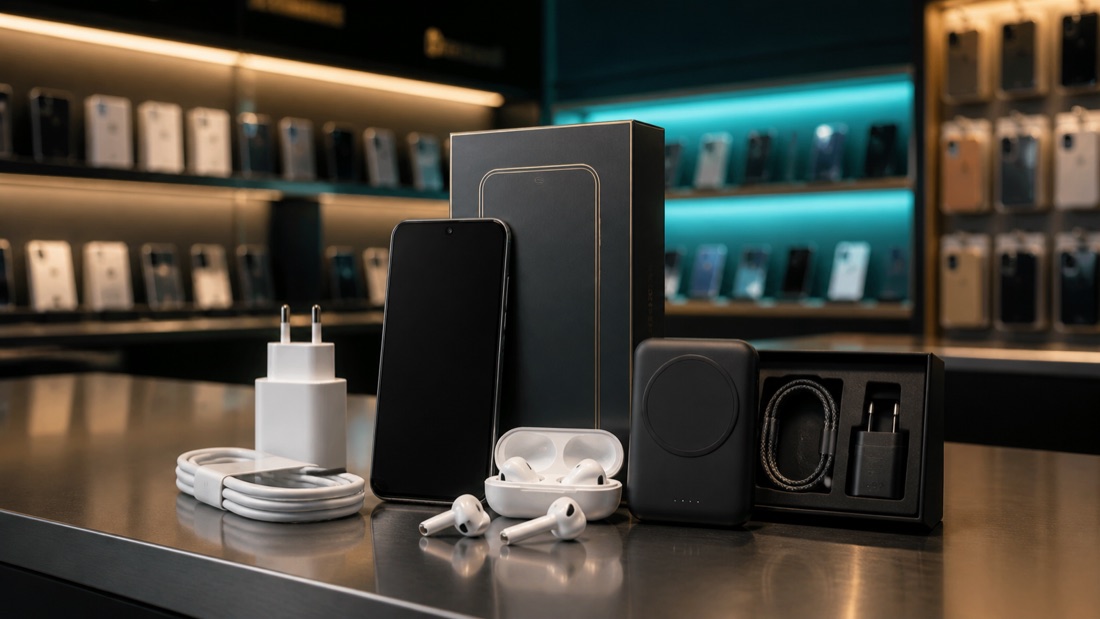
A retail bundle needs a clear use for the shopper, a workable margin and a simple way to replenish it. A random mix of accessories rarely meets all three conditions.
Use the phone accessories wholesale catalog to confirm the available product families before turning the shopper moment into a repeatable bundle.
When the bundle includes backup power, compare the power bank wholesale route by capacity, output, cable configuration and destination requirements.
Before allocating slow-moving power-bank stock to a retail kit, use the power-bank storage register to check the matching manufacturer instructions, storage history and recorded hold decisions.
Before booking onward transport for a bundle that includes backup power, use the power-bank UN38.3 document matching matrix to link the exact power-bank model code and Watt-hour marking to its test summary.
Key Takeaways
- Bundle value should be clear to the shopper in one glance.
- Accessory quality and plug type must match the destination market.
- Mixed-SKU replenishment needs a simple repeat order structure.
Match the bundle to a shopping occasion
A student starter pack needs a different accessory mix from a driver’s work kit or a gift-ready family phone pack. Start with the shopping occasion, then select the phone and accessories bundle. Specify charger wattage and cable length, and decide whether the kit needs earbuds, a case, a screen protector or a particular power bank capacity.
The result should look intentional to the shopper rather than like excess inventory packed together.
Define the retail offer
- Target shopper
- Phone class
- Accessory quality tier
- Retail display format
Build the BOM from the shelf slot backward
Give each bundle a kit code and a specific retail purpose, such as a new-phone starter pack, travel-charging pack or premium desk-charging pack. List every sellable component. Where the kit includes a phone, record its model and regional version. For the accessories, record the charger SKU and wattage, plug type, cable connector, current rating and length, power-bank capacity and outputs, earbuds, case, screen protector, inserts and retail packaging. State the quantity of every component in one kit and the total number of kits. A carton count alone cannot prove that the supplier packed complete bundles.
Record the target shelf price band and the value offered to the shopper. This keeps an expensive component out of a price-led kit and prevents a weak accessory from undermining a premium bundle. Put artwork, barcode ownership, packaging language and mandatory market labels on separate BOM lines. That distinction stops design files and compliance evidence from being mistaken for physical stock.
BOM controls
- Kit code and BOM revision shown on the quotation and packing list
- Exact SKU, electrical rating, colour and quantity for every component
- Approved phone compatibility list for cases, protectors, cables and chargers
- Buyer- or supplier-owned artwork, barcode, label and insert files
- Retail-pack quantity, inner-box quantity and master-carton quantity
Test electrical and physical compatibility together
A USB-C connector does not by itself prove that the kit will deliver the intended charging result. Test the nominated charger and cable with every approved phone model. Record the negotiated charging mode, stability, heat and the time needed to reach the buyer’s chosen checkpoint. For a power bank, test every claimed output with the supplied cable, then confirm that its capacity and markings match the approved sample. Any certification or transport document should identify the exact product and revision it covers.
These kit tests apply only to the same approved configuration. If a part, model, protocol or pack changes, repeat the checks that change affects. The phone accessories bundle route already says a part change after approval must be retested. Accepting a later ordered batch of chargers or power banks against its own order line is a separate exercise, covered in the charger and power bank wholesale QC checklist. For the cable line itself, use the Android cable SKU guide to separate connector pairs, power declarations and data requirements before selecting the bundle component.
Component tests will not catch every physical fit problem, so assemble the complete retail kit as well. Check that the case aligns with the buttons, camera and ports. The screen protector must fit both the display and the case edge, and a thick case must not obstruct a docking station or wireless charging position. Photograph the assembled sample, product labels and retail pack. Keep this golden-sample evidence with the BOM so incoming inspection can compare the same configuration.
Treat substitutions as controlled exceptions
Mark each line as locked, equivalent substitute allowed or buyer approval required. An equivalent substitute still needs firm limits for plug standard, supported protocol, minimum power, cable rating and length, power-bank capacity, approved phone fit, colour family, label language and retail tier. “Similar accessory” is not a usable rule because it gives inspection no standard for what must remain unchanged. If a charger or cable may need replacement, record the approved alternative before stock runs out.
When stock changes, document the original SKU and proposed replacement, the affected kit quantity, the reason for the change, the evidence reviewed and the approver. Issue a new BOM revision and use it on the quote, packing list and carton label. A temporary exception applies to one shipment unless the buyer explicitly makes it part of the replenishment standard.
Approve one trial carton before the repeat cycle
Pack a trial carton with the same inner boxes, protective layers and orientation planned for production. Verify the complete-kit count, barcode visibility, carton marks, gross weight and dimensions. Store staff should also be able to identify a kit without opening several boxes. Photograph the open layers and the closed carton. Before production, agree on the number of cartons to sample and which mismatch will stop release.
After launch, track sell-through, returns and accessory failures by kit code and BOM revision. Use the accepted record to replenish fast lines. Adjust slow combinations deliberately, and order spares for components that fail more often than complete kits. Send the next quantity plan with the same revision and mark every requested change clearly. This shortens requoting without losing the approved compatibility or retail presentation.
Keep repeat orders simple
A bundle can sell well and still become difficult to manage if every reorder starts a fresh negotiation. Keep the BOM, packaging language, carton details and substitution rules together, especially when an order combines wholesale phones with several accessory SKUs.
Reorder record
- Bundle BOM
- Packaging files
- Carton quantity
- Substitution rules
Evidence and standards
USB-IF’s cable and connector guidance explains USB-C power-capability marking and compliance testing. Its certified product search lists products qualified to use the USB-IF logo. For bundles that contain power banks, review IATA’s current battery transport guidance with the selected carrier before fixing the packing plan.
Request a quote
Submit the target phone model, accessory list, plug type, packaging language and carton quantity through the retail bundle RFQ.
What to send us
We reply within 1 business day.
| Item | Why we need it | Example format |
|---|---|---|
| Target phone model | Needed to price the line and check the published terms | [buyer fills] |
| Accessory list | Needed to price the line and check the published terms | [buyer fills] |
| Plug type | Needed to price the line and check the published terms | [buyer fills] |
| Packaging language | Needed to price the line and check the published terms | [buyer fills] |
| Carton quantity | Needed to price the line and check the published terms | [buyer fills] |
We reply within 1 business day.
Replenishment RFQ fields
- Current kit code and BOM revision
- Sell-through period and quantity requested per kit
- Component-level returns, failures and spare requirement
- Locked items and proposed changes requiring approval
- Required packing date, delivery handoff and next review cycle
Questions already answered on this page
Who approves an accessory replacement in a bundle?
The buyer. Mark each line as locked, equivalent substitute allowed, or buyer approval required.
Can another USB-C cable replace the one on the BOM?
Not by the connector name alone. An equivalent substitute still needs the plug, protocol, power, cable rating, length and phone fit the buyer wrote down.
How do you keep a kit from shipping with a missing piece?
List the quantity of every component in one kit and the number of kits. A carton count alone cannot prove that the bundles are complete.
Does a one-shipment exception become the reorder rule?
No. A temporary exception applies to one shipment unless the buyer explicitly makes it part of the replenishment standard.
How is bundle quantity counted?
Count every component in one kit, then the number of kits. Do not use the carton count as the component quantity.