
Yes, power banks can deteriorate even if they are not used. Stored charge can fall, and prolonged non-use does not preserve the battery indefinitely. An unopened carton is not evidence of battery condition. The exact model’s instructions and the stock’s history determine the next step; there is no expiry date established by this guide.
For a retailer, the useful response is a record: which unit and lot, which manufacturer instructions, how it was stored, what was observed and who reviews it next. Use the power banks wholesale range for assortment planning and the register below for inventory already waiting on the shelf. If the stock will become part of a retail kit, carry its review status into the store-ready accessories bundle plan.
Key Takeaways
- Non-use does not establish that a power bank is fit for resale.
- Record storage and maintenance instructions against the exact model and document version.
- Keep charge observations separate from capacity ratings and safety decisions.
- Leave missing history unknown and assign an owner to resolve it.
What does “go bad” mean for unused stock?
A low charge indication, reduced usable capacity and visible damage are different findings. A recharge is not a general remedy for all three.
The manufacturer’s long-term storage answer describes power consumption during storage and reduced chemical activity during extended non-use. It supports checking idle stock; it does not establish a shelf life for an unidentified wholesale unit.
| Finding or question | What the record can establish | What remains unresolved |
|---|---|---|
| Lower charge indication than at the last check | The dated indication on the named unit | Whether capacity has declined, or why the indication changed |
| Shorter observed run time | What happened under the recorded conditions | Whether conditions match the earlier check or a published rating |
| Swelling, cracks, leakage, damage or unusual heat | A reason to stop ordinary use and escalate | The fault cause and manufacturer-directed handling |
| No storage history or matching manual | An evidence gap | A maintenance calendar or resale approval |
A power bank that lights up has not thereby passed a capacity or safety assessment. Keep printed ratings on the capacity comparison record; put storage history and observations in this register. Neither record replaces the manufacturer’s instructions.
Which instructions belong to this lot?
Match the model code, hardware or market revision where supplied, and supplier lot to the applicable manufacturer document. Keep its URL or file, document version and the date you checked it. If the document is undated, write “version not stated” and retain the copy instead of inventing a revision date.
Copy the storage environment, charge-level instruction, maintenance action and interval exactly as applicable to that model. Generic support advice can help identify questions, but do not use it to fill an unidentified SKU’s missing limits. When current model instructions and a general article appear to disagree, hold the maintenance decision for manufacturer clarification.

The manufacturer safety guide advises dry storage away from heat and direct sunlight, avoiding full depletion, and keeping ports dry. It also advises compatible charging equipment and prohibits disassembly. These precautions do not supply the temperature limits, charge target or recharge interval for every model in a mixed order.
Do not infer manufacture date from receipt date. Record both only when supported. If only the receipt date is known, leave manufacture date unknown. Similarly, an indicator pattern should be recorded as observed; translate it into a percentage only if the matching manual defines that pattern.
Copy a blank stock maintenance register
Create one master record per SKU, revision and supplier lot. Attach repeated inspection entries to it. If storage conditions or histories differ, keep those groups separate even when the cartons look identical. These are buyer record fields, not a claim that any lot has been tested.
| Master record field | Value to enter |
|---|---|
| Exact SKU/model, revision and market version | |
| Supplier lot and unit identifiers available | |
| Quantity and shelf/location reference | |
| Received date; documented manufacture date if available | |
| Manufacturer manual URL/file and version | |
| Document checked date and applicable section/page | |
| Required storage environment, copied from the document | |
| Required storage charge/indicator condition, if specified | |
| Permitted maintenance action and interval, if specified | |
| Known storage history and gaps | |
| Responsible owner and unresolved manufacturer questions |
Leave unknown cells blank or enter “Unknown / verify on the unit.” A receipt date, assumed room temperature or familiar recharge schedule is not a substitute for missing evidence. If the manual provides no interval, record that fact and ask the manufacturer; do not calculate a supposedly safe date from this article.
Use the following repeatable entry for each review. Name the units actually checked so a sample observation is not silently assigned to the entire lot.
| Review entry field | Value to enter |
|---|---|
| Review date, recorder and unit/sample IDs | |
| Observed exterior, ports and packaging condition | |
| Storage conditions observed and evidence reference | |
| Indicator observation, if appropriate under the manual | |
| Maintenance instruction used, with document locator | |
| Action actually completed and dated observation | |
| Hold/escalation decision, affected stock and owner | |
| Next review date, instruction basis and responsible person | |
| Supporting photo/file and manufacturer reply reference |
Keep the instruction, the completed action and the outcome separate. A scheduled recharge is not proof it occurred. A completed recharge is not proof that the original capacity remains. Missing documentation should remain an open item until the owner attaches the reply or matching manual.
What should stop the normal review?
Stop ordinary charging or use when swelling, leakage, cracking, damage or unusual heat is present. Do not charge an affected unit to see whether it still works, or return it to sale because its indicator turns on. Manufacturer battery safety advice explicitly calls for stopping use with these warning signs and contacting support for overheating or swelling.
Identify the affected units and hold them out of sale. Follow the manufacturer’s handling instructions and the applicable local battery-disposal process. This article does not prescribe a storage container, shipping method or repair procedure for damaged batteries. Do not open a case, bypass protection or attempt cell revival.

| Review result | Inventory decision to record |
|---|---|
| Warning sign or damage found | Stop ordinary use/charging; hold affected units; obtain handling instructions |
| No warning sign seen, but manual/history unresolved | Keep the unanswered fields open; assign clarification before maintenance or release |
| Matching instructions available and no stop condition observed | Follow only the permitted actions; record what was done and what remains to be checked |
| A buyer release decision is made | Record approver, evidence and scope; a visual check alone is not safety certification |
An exterior review can identify a stop condition. It cannot establish that the inside of a sealed battery is safe, explain a fault or approve every unit in a lot.
How should slow-moving stock be reviewed before sale?
Assign a person to the next review, with its timing supported by the applicable manufacturer instruction or clarification. Keep stock rotation linked to the record: earlier receipt can set a picking order, but it must not override a hold decision or an unresolved history.
For example, two cartons of the same model may have different receipt dates and different storage histories. Keep separate entries if one group’s history is unknown. Do not copy the other carton’s maintenance date into it, even when their packaging matches. This is an inventory example, with no assumed age, temperature or test result.
Before any release, resolve the recorded exceptions and apply the buyer’s agreed acceptance process. The charger and power-bank QC checklist covers acceptance against the order line. This storage record adds the history since receipt; it does not replace that acceptance decision or create a warranty promise.
Method and sources
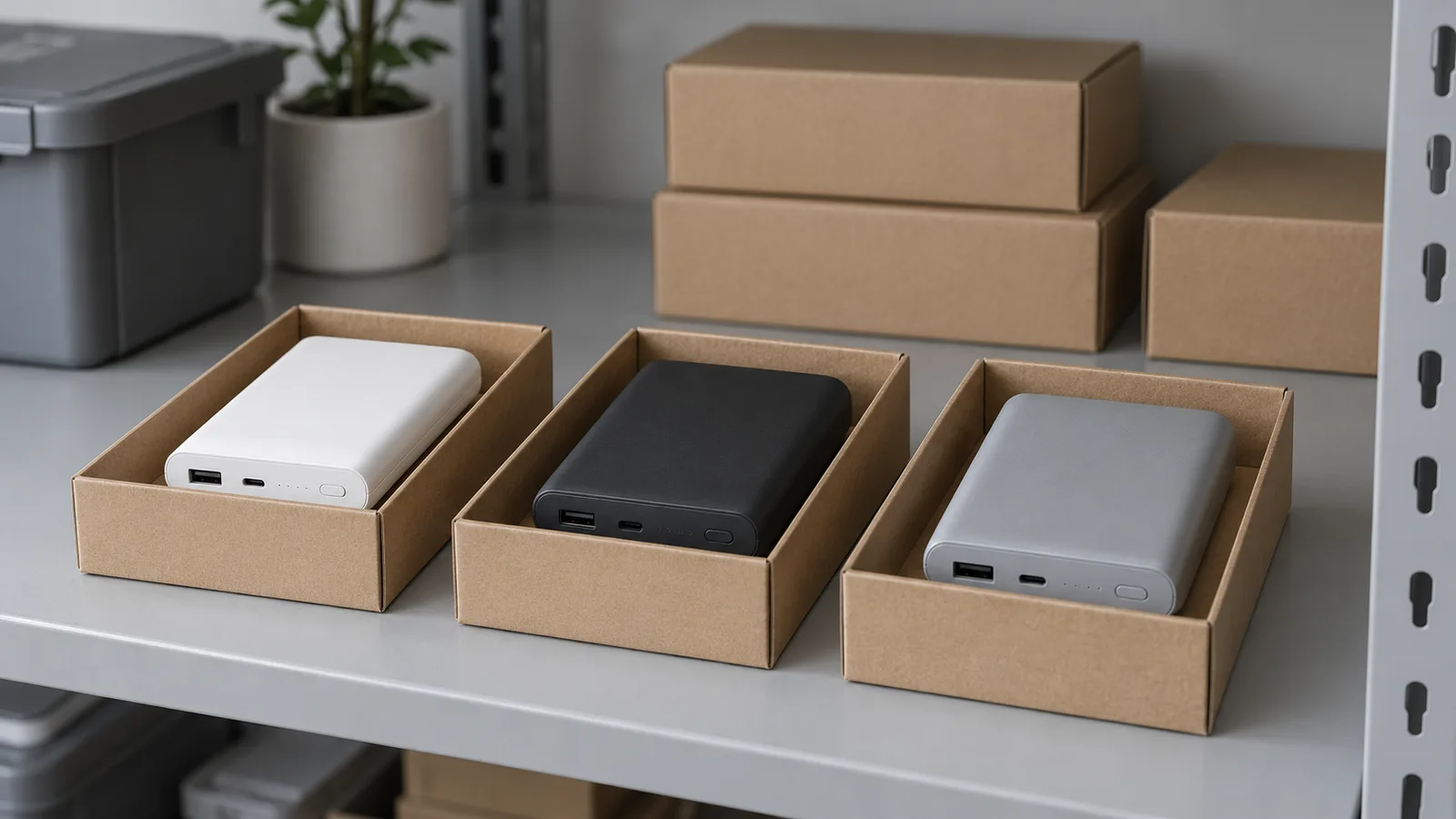
Reviewed 15 October 2026. This guide combines opened manufacturer storage and safety guidance with an original blank inventory worksheet. No stock sample, discharge test or failure-rate study was performed. The photographs show generic objects and do not document a shipment or a test.
- Manufacturer long-term storage support: non-use and storage advice; source-specific guidance.
- Manufacturer Power Bank Safety Guide: storage, charging habits and prohibited actions.
- Manufacturer battery safety guidance: warning signs and stop-use advice.
These documents do not establish the age, remaining capacity or saleability of NexusSupply inventory. Exact unit instructions and recorded evidence must fill those gaps.
What to send us
| Item | Why it matters |
|---|---|
| Exact model/revision and supplier lot | Identifies the stock under review |
| Manufacturer storage instructions and document version | Establishes the instruction basis |
| Received date and known storage environment/history | Separates known history from missing information |
| Exterior observations, maintenance record and unresolved questions | Shows the recorded condition and remaining decisions |
For a wholesale stock inquiry, send those model/lot details, manufacturer instructions, receipt and storage history, and observation record through the RFQ, leaving unknown fields blank.