
A mixed phone receipt is reconciled by comparing the physical devices in hand with the expected order lines and cartons. Count phones, not identifier rows. Write every missing, extra, duplicate or mismatched record before those units are entered as stock.
Start from the models in the mobile phone wholesale catalog. The mobile phone wholesale QC checklist still governs photos, video and physical checks. This page only closes the receipt record.
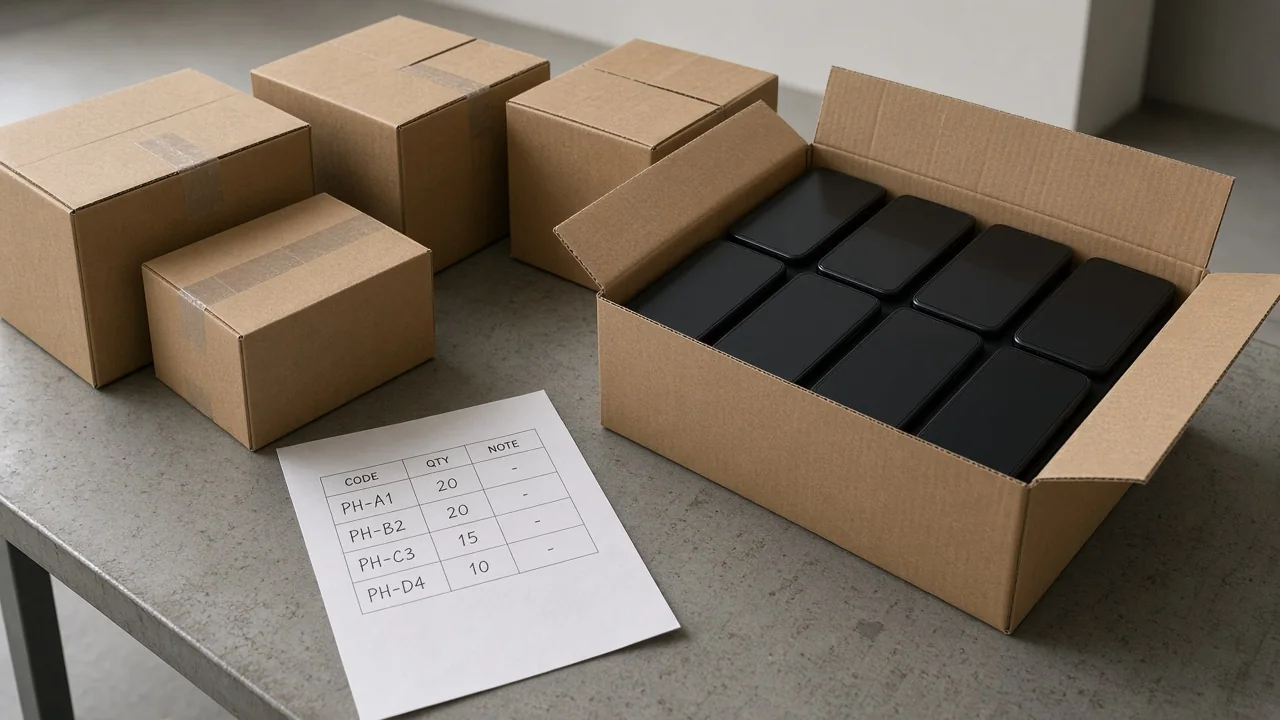
How is inventory reconciliation done for a mixed phone order?
Compare the expected order lines with the devices and cartons actually received. Record each device identifier as text, with its identifier type, then mark missing, extra, duplicate and mismatch exceptions before stock entry.
A storewide cycle count, a supplier-background check and a condition grade are different jobs. They are named at the end of this page so they are not folded into the receipt record.
Key Takeaways
- Reconcile the received phones against expected order lines and cartons, not against a product family.
- Store each identifier as text, with its type. A 15-digit IMEI is an identity, not a quantity.
- Two identifier rows can still be one physical device. The same type and value recorded twice is a duplicate.
- Missing, extra, duplicate and mismatch rows need an evidence reference and a buyer disposition before stock entry.
Copy this blank worksheet
Use one row per identifier record. Leave cells blank until the receipt fills them. Do not paste live identifiers into a published copy of this page.
| Order line | Model / variant | Identifier type | Device identifier | Carton | Receipt time | Exception | Evidence reference | Buyer disposition |
|---|---|---|---|---|---|---|---|---|
Exception is one of: missing, extra, duplicate, mismatch. Leave it blank when the row matches. Buyer disposition is the buyer’s own next decision, such as accept, clarify, hold or reject. This sheet does not record a location, a battery reading, a grade, or a network-status result.
A hypothetical three-line example
Every identifier below is a placeholder. None of these tokens is a captured device, a customer shipment, or a measured count.
| Order line | Model / variant | Identifier type | Device identifier | Carton | Receipt time | Exception | Evidence reference | Buyer disposition |
|---|---|---|---|---|---|---|---|---|
| L2 | Example phone, 256 GB, black | IMEI | HYP-IMEI-01 | C-02 | 2026-10-12 09:10 +08 | note-C-02 | accept | |
| L2 | Example phone, 256 GB, black | IMEI | HYP-IMEI-01 | C-02 | 2026-10-12 09:12 +08 | duplicate | note-C-02 | clarify |
| L2 | Example phone, 256 GB, black | serial | HYP-SERIAL-01 | C-02 | 2026-10-12 09:10 +08 | note-C-02 | accept | |
| L3 | Example phone, 128 GB, blue | IMEI | HYP-IMEI-02 | missing | unresolved | |||
| Example phone, 128 GB, blue | IMEI | HYP-IMEI-09 | C-04 | 2026-10-12 09:20 +08 | extra | note-C-04 | hold |
Read the example as a set, not as stock. L2 was expected. HYP-IMEI-01 appears twice, so the second row is a duplicate, not a second phone. HYP-SERIAL-01 is a second identifier type on that same expected device, so it does not add a unit. HYP-IMEI-02 was expected and is absent, so it is missing. HYP-IMEI-09 arrived in C-04 without an order line, so it is extra. If an identifier arrives on the wrong model, variant or carton, mark mismatch instead of extra.

Keep the identifier as text
The GSMA Device Check FAQ describes IMEI as the 15-digit electronic serial number of a GSM cellular device, and MEID or ESN as the identifiers used on CDMA devices. It also says a Wi-Fi-only device does not carry those cellular identifiers. Quote the identifier the device actually shows. Do not invent an IMEI for a device that has none.
The same FAQ says the identifier can be displayed by entering *#06# on the phone keypad. On some devices it is also printed on a label behind the back cover or under the battery. Those are ways to read a value. They do not prove ownership, authenticity, or that the device will stay eligible on a network.
Microsoft’s Excel specifications and limits list number precision as 15 digits. A 15-digit IMEI already sits on that limit, so a numeric cell is the wrong container. Store the identifier as text, including the identifier type in its own column.
Count devices when one phone has two rows
A physical count and an identifier count answer different questions. The GS1 Global Traceability Standard, Release 2.0 (ratified August 2017), describes instance-level identification as a serialised ID for one individual instance (pages 10 and 29). It does not name IMEI as a GS1 identifier. Use that distinction locally: one phone is one instance even when the worksheet has two rows for it.
If the device shows more than one identifier, give each value its own row and its own type. The quantity for that handset stays one. A duplicate is only the same type and the same value recorded again.

Join the carton to the order line
The same GS1 standard, requirement R21 on pages 39–40, says a shipment or receipt record needs the identifier of the objects and the despatch or receipt date. Requirement R25 says packing or unpacking should keep the parent-child relationship at each containment level. Requirement R23 also asks for an event time with its time zone and a disposition. Page 29 says the link between a higher aggregation level and the items it contains has to be recorded.
The worksheet uses those ideas with the identifier the phone actually carries. The carton is the parent. The device identifier is the child. The receipt time includes the time zone. The buyer disposition is the local decision on that row. R23 also records a location. This worksheet does not. It is not a location log, a traceability system, or a GS1 message.
Plan the mixed lines before the goods arrive with the mixed-SKU wholesale order guide. The reconciliation on this page starts only when the cartons are in hand.
What this record does not decide
Supplier legitimacy is a separate check. Use the supplier verification guide for that question. A matching identifier does not prove who owned the device, who may sell it, or that a payment should be released.
A block-list result is also a different check. The GSMA FAQ says a Green status means the device IMEI is not currently flagged on the GSMA Block List, and a Red status means it has been flagged. Green is not an ownership proof, a finance clearance, or a promise of permanent network eligibility. This page does not provide block-list lookups or a clean-IMEI guarantee.
Condition, battery health and parts history belong on the used iPhone grading checklist when the lot is graded used stock. Do not turn this receipt sheet into a grade. It also does not cover ERP sales posting or managed kitting.
Method and sources
Read 12 October 2026. Competitor inventory guides were used only to see what they omit. The claims above are limited to the pages named here.
- GSMA Device Check FAQ — IMEI as a 15-digit GSM identifier, MEID and ESN, Wi-Fi-only devices, *#06# display, and the meaning of a current Green or Red block-list status.
- GS1 Global Traceability Standard, Release 2.0 — ratified August 2017, pages 10–12, 29 and 39–40, including requirements R21, R23 and R25. IMEI is not treated as a GS1 key.
- Excel specifications and limits — number precision listed as 15 digits.
What to send us
We reply within 1 business day.
| Item | Why we need it | Example format |
|---|---|---|
| Order lines with model and variant | Needed to price the line and check the published terms | [buyer fills] |
| Redacted identifier list, with identifier type, stored as text | Needed to price the line and check the published terms | [buyer fills] |
| Carton numbers joined to those lines | Needed to price the line and check the published terms | [buyer fills] |
| Receipt time, exception and buyer disposition for each difference | Needed to price the line and check the published terms | [buyer fills] |
We reply within 1 business day.
Send the order lines, model and variant, a redacted identifier list, carton numbers and the exception notes in an RFQ.