

Before paying a mobile phone supplier in China, check the Chinese legal entity against the contract and proforma invoice. Confirm the bank beneficiary through an independent channel and ask for evidence tied to the stock you are considering. Product claims, inspection terms and delivery responsibility can then be tested through a commercially meaningful trial order. No single certificate, video call or database result can do all of that work.
This is a procurement-risk framework. It is not legal, banking or import advice. For a material order, involve the buyer’s bank, freight provider and qualified counsel where appropriate.
Who this guide is for
This guide is for mobile phone wholesalers, independent retailers, regional distributors, ecommerce resellers and first-time importers preparing to send T/T, open an L/C or approve a first order with a supplier in China.
It is most useful after the buyer has received a quotation or proforma invoice and needs to see whether the supplier, goods, documents and payment path describe the same transaction. Buyers who are still defining products and quantities should start with the complete China mobile device sourcing guide.
Key Takeaways
- Verify the supplier under its Chinese registered name or Unified Social Credit Code instead of relying on an English trading name.
- Match the registered entity, contracting party, proforma invoice seller and bank beneficiary before payment.
- Treat every bank-detail change as a new verification event and confirm it through a previously verified channel.
- Ask for current, order-specific stock evidence; catalog images and an active registration do not prove inventory.
- Separate company identity, brand authorization, product authenticity, regional version and stolen-device status into different checks.
- Use a first trial order to test specification, inspection, packing, documents and handoff. A sample that powers on does not test the full process.
Seven checks before payment
The checks below establish who is selling, what goods are available and where the payment will go. Look for consistency across independent sources, commercial documents, live evidence and direct confirmation. A polished document on its own proves very little.
| Check | Evidence to request or verify | Pause trigger |
|---|---|---|
| 1. Legal identity | Chinese legal name, Unified Social Credit Code, business licence and official registry result | Name, code, status or address cannot be reconciled |
| 2. Contract / PI party | Seller named consistently on the quotation, contract and proforma invoice | A different company appears without explanation |
| 3. Bank beneficiary | Beneficiary name, bank country and account details confirmed through a known contact | Personal, unrelated or newly changed account details |
| 4. Contact consistency | Company-domain email, established phone number, address and website history | Lookalike domain, urgent channel switch or conflicting contact details |
| 5. Current stock | Dated, order-specific photos or live video showing models, labels, quantities and cartons | Only catalog images, old videos or refusal to show requested identifiers |
| 6. Brand and product claims | Model codes, source or authorization evidence where claimed, sample serial / IMEI checks | Broad “authorized” claim with no current scope or traceable evidence |
| 7. Price, terms and trial order | Comparable quote, complete PI, inspection terms, delivery boundary and exception rules | Extreme price gap, missing terms, pressure to pay before inconsistencies are resolved |
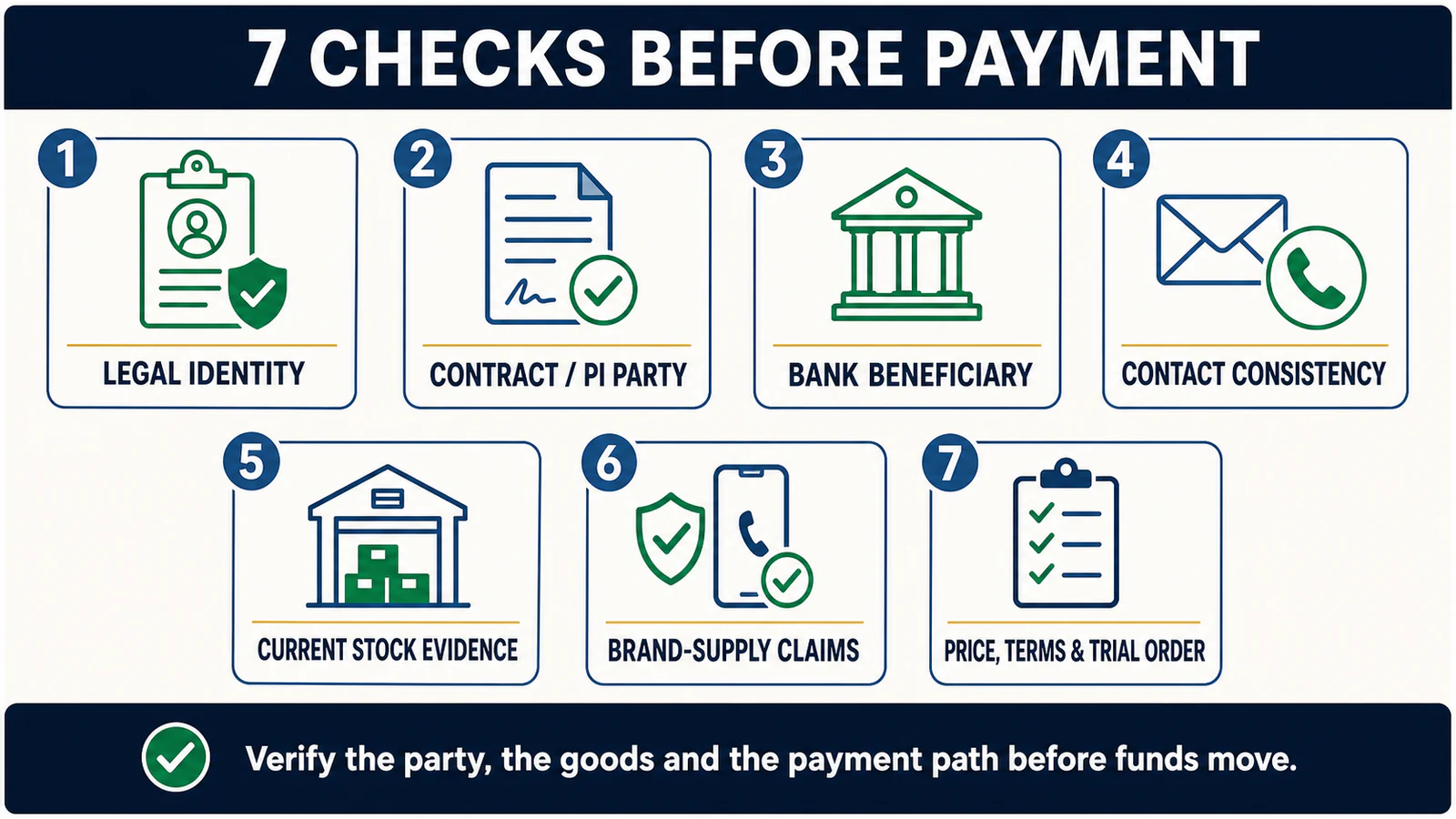
The diagram is a procurement checklist. It is not a substitute for legal, banking, product or destination-market checks.
1. Verify the Chinese legal company name
Start with the supplier’s Chinese registered name and Unified Social Credit Code. An English brand or sales name can help communication, but it may not be the name registered with Chinese authorities or the party legally responsible for the order.
Ask the supplier for:
- A current business-licence copy;
- The Chinese legal company name in text as well as on the licence image;
- The Unified Social Credit Code;
- The registered address;
- The name of the entity that will issue the quotation, contract and PI.
Search that information in China’s official National Enterprise Credit Information Publicity System. The system’s official help page explains that users can search by company name or Unified Social Credit Code and that disclosed information comes from market-regulation authorities, other government bodies and companies themselves. Review the registration status, legal representative or responsible person, address, business scope, annual-report history, administrative penalties and any operational-abnormality or serious-illegality records that are publicly shown.
Use the registry to check identity and visible risk records. Do not treat it as a government endorsement. An active company record does not prove that the supplier owns the products, controls a warehouse, has brand authorization or will perform the contract. Registered capital is not the same as cash available to repay a buyer. Under China’s current company-law framework, limited-company registered capital is based on subscribed shareholder contributions.
If the supplier cannot provide its Chinese legal name, or the licence details cannot be reconciled with the official record, stop before moving to payment verification.
Checklist
- Chinese legal name copied exactly from the licence
- Unified Social Credit Code
- Registration status and registered address
- Legal representative or responsible person
- Business scope relevant to the transaction
- Annual-report, penalty and abnormal-operation records reviewed
- Seller name that will appear on the contract and PI
2. Match the contracting entity and bank beneficiary
Before payment, create a three-way match between the registered legal entity, the seller on the contract or PI and the named bank beneficiary. Add the quotation seller as a fourth line when it is issued by a different entity.
The records should show an understandable payment path. Exact English spellings can vary because of transliteration or bank-record conventions, so a character-for-character English comparison is not enough. Read the Chinese legal identity, account documents and written commercial explanation together.
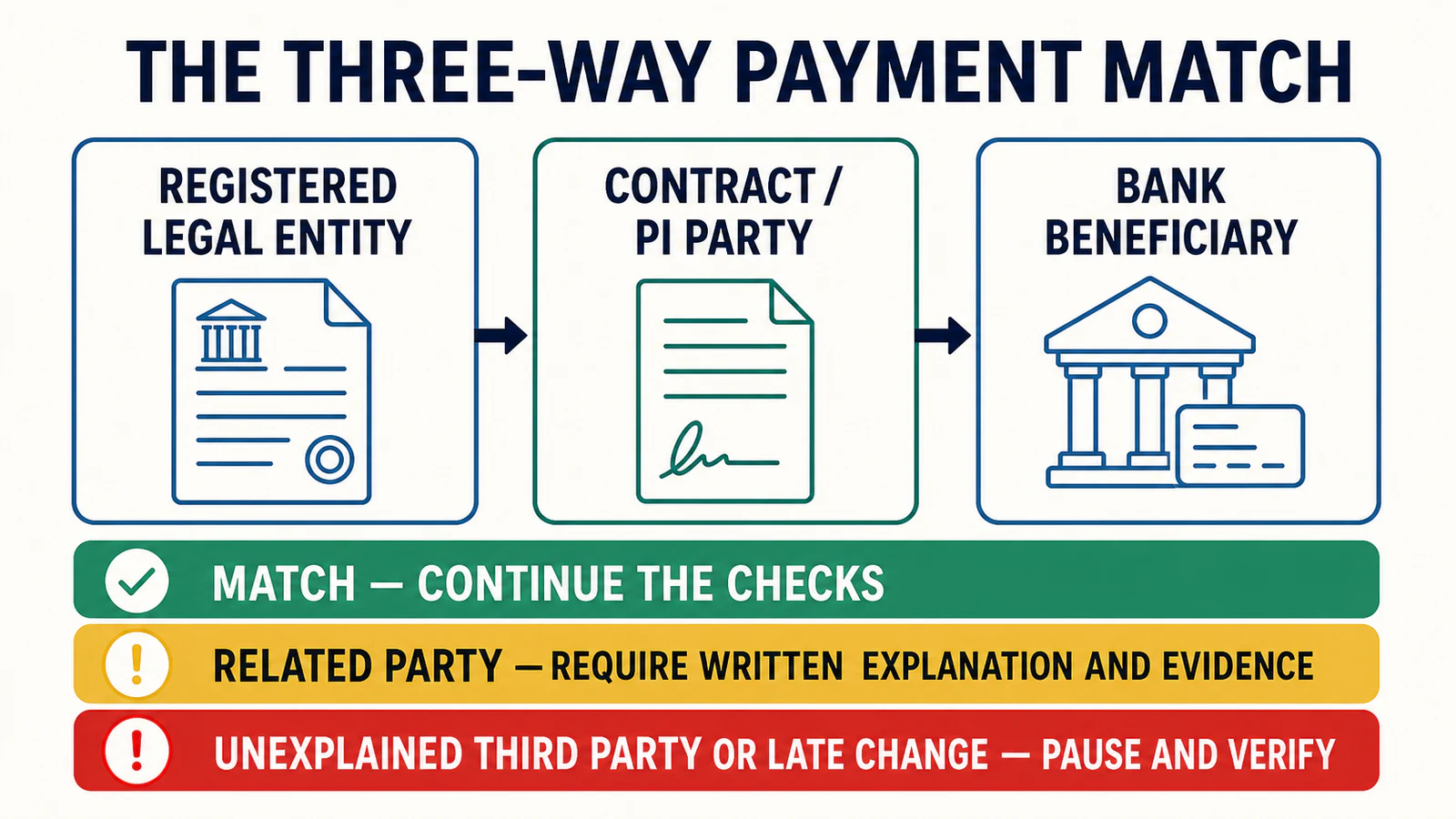
A beneficiary mismatch requires an explanation, but it is not automatic proof of fraud. A mainland supplier may have a disclosed Hong Kong affiliate, export agent or regulated payment provider. If so, request:
- The full legal name and registration details of both entities;
- A written explanation of the commercial relationship;
- Evidence connecting the beneficiary to the contracting seller;
- Payment instructions issued or confirmed by the contracting seller;
- A revised PI or agreement that accurately states the payment path.
Do not approve a newly supplied beneficiary using only the same email, WhatsApp or WeChat conversation that delivered the change. The FBI’s Business Email Compromise guidance advises businesses to confirm payment requests and account changes through an independently verified channel. INTERPOL’s BEC guidance likewise recommends contacting the recipient through another channel rather than replying directly to the change message.
Call a previously verified number, involve a second approver inside your company, compare the new instruction with retained records and ask your bank to review anything unusual. If funds have already been sent to a suspected fraudulent account, contact the sending bank immediately and follow the appropriate law-enforcement reporting process in your jurisdiction.
Checklist
- Registered company name
- Seller named on quotation
- Contracting party
- Seller named on PI or invoice
- Bank beneficiary name and bank country
- Written explanation and relationship evidence for any different beneficiary
- Payment change verified through a previously known channel
- Second internal approval before funds move
3. Check the website, email and business contacts
Digital records can support supplier verification, but they do not replace company and payment checks. Compare the website and email domains, telephone numbers, address, company name and contact person across the site, quotation, PI and earlier conversations.
Use the official ICANN Registration Data Lookup to review publicly available domain-registration dates, registrar information and domain status. ICANN notes that some registrant information may be redacted, so an incomplete record is not automatically suspicious. A long-established domain is useful context; it is not proof of inventory or honest performance.
Changes deserve more attention than cosmetic polish. Independently confirm a one-letter lookalike domain, a sudden move from a company mailbox to a free email address, a new phone number introduced with urgent bank instructions or a website address that conflicts with the licence.
Free email, WhatsApp or WeChat use is common in cross-border trade and is not by itself proof of a problem. The question is whether those channels connect consistently to the registered company and whether payment instructions survive verification through a channel you already trust.
4. Request current stock and warehouse evidence
An active company may not hold the quoted stock. Ask for evidence tied to the order under discussion, rather than a generic showroom video or supplier catalog.
A useful stock-evidence request specifies:
- The exact brand, model code, regional version, RAM, storage, color and condition;
- The quantity the supplier claims is available;
- A current date or buyer-selected reference shown during a live video;
- Close views of product labels and outer-carton labels;
- A random buyer-selected carton, model or serial sample;
- The packing configuration and where inspection will take place.
For larger or higher-risk orders, consider a live video walkthrough or an independent warehouse inspection. Ask the presenter to move from a wider warehouse view to a buyer-selected carton and label in one continuous sequence. This reduces the value of reused clips, although it still does not guarantee later delivery of the same goods.
The hero image on this page is an illustration. It is not evidence of a specific supplier, warehouse or inventory batch. Current-stock proof must come from the actual order and should be kept with the transaction records.
Once the order is fixed, use the mobile phone wholesale quality control checklist to turn that request into a structured photo, video, record and packing-evidence pack before the next agreed payment step or pickup.
5. Test brand-supply and product-authenticity claims separately
Company identity, brand authorization, product authenticity, regional version, warranty eligibility and stolen-device status require separate checks. Passing one check does not settle the others.
If a supplier says it is “authorized,” ask what the claim covers: which legal entity, brand, territory, product line and validity period. Request the current authorization or source document and verify it through contact details obtained independently from the brand or issuing distributor. A business scope that includes electronics does not prove brand authorization.
For new phones and tablets, compare the model code, regional version, capacity, packaging label and product identifiers with the quotation and the manufacturer’s official model information. The commercial model name alone is not enough. The complete phone sourcing guide explains why version, network, software, SIM and packaging checks belong in the RFQ.
For Android stock, use the global-versus-China-version checklist to record the model code, build, Play Protect status, SIM/eSIM configuration, packaging and support region before payment.
For Xiaomi devices, the brand provides an official product-authentication service. For Apple devices, use Apple’s official model-identification and service-coverage resources as corroborating checks, not as conclusive proof of authenticity or condition.
For used devices, match a sample of IMEI or serial identifiers across device settings, the physical device, the box where applicable, the inspection record and the final list. GSMA Device Check can report whether an identifier is currently flagged as lost or stolen and can help compare device identity. GSMA’s terms also make clear that its block-list data has limitations, so a clean result does not guarantee that a device is genuine, finance-free, permanently unblocked or acceptable in every destination market.
Buyers planning pre-owned inventory should combine identifier checks with the condition, battery, parts and lock requirements described on the used iPhone wholesale page.
6. Review the quotation and proforma invoice as control documents
A quotation and PI should record more than the price. They need to preserve the assumptions used to decide whether the delivered batch matches the order.
Before payment, confirm that the documents state:
- The seller’s legal name and company details;
- The buyer’s legal or trading name;
- Brand, exact model or SKU, regional version and condition;
- RAM, storage, color and quantity;
- Unit price, total amount and currency;
- Quote-validity period and payment method;
- Bank beneficiary and bank details;
- Packaging, labels and included accessories;
- Inspection scope and evidence;
- Permitted substitutions and who approves them;
- Delivery location and the point where supplier responsibility ends;
- Documents due before balance payment or handoff;
- Process for shortages, failed units or material non-conformity.
Use the wholesale quote comparison guide to normalize offers before deciding that one supplier is cheaper. Then check the actual handoff described in the mainland China and Hong Kong delivery guide. A low unit price is not a completed transaction if packing, inspection, handling or onward delivery assumptions remain unresolved.
For material orders, qualified counsel can advise on the contracting entity, signer authority, company chop, governing law and dispute mechanism. A red company chop or signed PDF should not be treated as a standalone guarantee of enforceability.
7. Structure a controlled first trial order
A trial order should test the normal commercial process at a manageable exposure. One sample product cannot do that.
Design the first order to answer:
- Did the supplier quote the exact requested versions?
- Were stock and substitutions communicated before payment?
- Did inspection evidence match the agreed standard?
- Were quantities, serial lists and carton labels accurate?
- Did the packing protect the products?
- Did the supplier meet the agreed mainland China, Hong Kong or courier-pickup handoff?
- Were exceptions handled in writing?
- Can the process be repeated without rebuilding it from zero?
Use the smallest order that is commercially meaningful for your category and supplier terms. Avoid spreading a trial across so many variants that no SKU produces a useful sales result. NexusSupply’s current starting points and mixed-SKU logic are explained in the guide to why phone wholesale MOQ differs by SKU.
For higher-value first orders, discuss bank-supported or professionally administered payment structures with your bank and counsel. A documentary credit can reduce specific payment and documentary risks when correctly structured, but banks examine documents, not the physical quality or authenticity of the goods. Payment structure never replaces precise specifications and inspection.
Red flags that require more evidence
No signal below proves fraud by itself. Slow down, identify the inconsistency and require independent evidence before payment.
| Signal | Possible legitimate explanation | Buyer action |
|---|---|---|
| Company cannot provide its Chinese legal name | Sales contact only knows the English brand | Require the licence name and code before continuing |
| PI seller differs from the quoted supplier | Group company or export entity | Document the relationship and revise the agreement |
| Beneficiary is a different or personal account | Disclosed agent or payment provider may be involved | Pause; obtain written authority and independent confirmation |
| Bank details change immediately before payment | Genuine operational change is possible | Treat as a new verification event and call a known contact |
| Only catalog photos are available | Stock may be upstream or not yet allocated | Request dated, order-specific evidence or inspection |
| “Authorized” is used without scope | Sales language may be imprecise | Verify the legal entity, territory, product and validity period |
| Price is far below normalized quotes | Different version, condition or exclusions | Reconfirm the full specification and included services |
| Supplier creates urgency before questions are resolved | Allocation may be time-sensitive | Do not let a validity clock override payment controls |
A 15-minute supplier verification workflow
Use this sequence after receiving a quotation and before approving payment:
- Copy the Chinese legal name and Unified Social Credit Code from the licence.
- Search the official enterprise registry and save the result with the review date.
- Put the licence entity, quotation seller, PI seller and bank beneficiary into one comparison table.
- Independently call a previously verified contact to confirm the payment path.
- Request dated, order-specific stock evidence for buyer-selected models or cartons.
- Normalize product, version, condition, quantity, inspection and delivery terms on the PI.
- Record who approved the supplier, documents and beneficiary before the transfer.
If one item cannot be reconciled, do not compensate by collecting more copies of the same type of evidence. A second document sent by the same salesperson is not independent verification.
Example: a different beneficiary appears on the PI
Assume a buyer receives a quotation from a mainland Chinese electronics company. The PI later instructs payment to a Hong Kong company with a different English name. The salesperson explains that the Hong Kong entity handles overseas receipts.
The explanation may be commercially legitimate, but it is not enough by itself. The buyer should pause and request the Hong Kong entity’s registration details, a written explanation of the relationship, authorization from the mainland contracting seller and a PI or agreement that identifies the beneficiary accurately. Confirm the arrangement through an established contact and ask the bank to review the payment instructions.
If the parties and payment path become clear and documented, the buyer can continue the remaining product and inspection checks. If the relationship stays unexplained or the supplier pressures the buyer to ignore the mismatch, the buyer should not send the funds.
What supplier verification cannot prove
Supplier verification reduces uncertainty. It does not create a guarantee.
- A registry result proves that a record exists, not that the quoted inventory exists.
- A business licence does not prove brand authorization.
- A warehouse video does not prove ownership or future delivery of every carton shown.
- A valid serial or IMEI result does not prove the whole batch is genuine or correctly graded.
- A successful sample does not prove that the production or used-device batch will match it.
- An inspection report only covers its stated scope, sample and date.
- An L/C or other payment structure does not prove physical product quality.
Base the payment decision on independent identity checks, consistent commercial documents, order-specific evidence, a defined inspection and a controlled first transaction.
Supplier verification checklist
Use this checklist as the payment-approval record for the first order.
Checklist
- Chinese legal name and Unified Social Credit Code verified
- Registration status, address and risk records reviewed
- Quotation, contract and PI seller reconciled
- Bank beneficiary and relationship documented
- Any payment change confirmed through an independent channel
- Website, email, phone and address checked for consistency
- Current stock evidence received for selected models or cartons
- Brand or authorization claims verified within their stated scope
- Product model codes, versions and identifiers sampled
- PI includes specification, quantity, price, inspection, substitution and delivery terms
- Trial-order objectives and acceptance criteria recorded
- Internal approver named and verification evidence retained
Does an active Chinese business licence mean a supplier is safe?
No. An active registration helps verify legal identity and public status, but it does not prove that the company owns stock, has brand authorization, is financially strong or will perform a particular order. Use the registry as one layer in a broader verification chain.
What if the bank beneficiary is not the supplier’s mainland company?
Pause and obtain a documented explanation. A disclosed Hong Kong affiliate, export agent or regulated payment provider may be legitimate, but the buyer should verify the relationship, authority and payment path independently before transferring funds.
Is a live warehouse video enough?
No. A live video is stronger than a catalog photo when it follows buyer-selected instructions, but it does not by itself establish ownership or guarantee delivery. Match it with the supplier identity, PI, labels, inspection and final handoff records.
Can I verify a supplier using only Alibaba, a marketplace badge or social media?
No. Platform history and public profiles can support context, but they should not replace the official company record, contracting-party review, beneficiary verification and current-stock evidence.
Does a valid IMEI prove that a phone is genuine?
No. An IMEI or serial lookup is a corroborating check. Match identifiers across the device, settings, packaging and records, and separately assess model, condition, locks, parts, warranty and block-list status.
What should I do if bank details change after the PI is approved?
Stop the payment workflow. Confirm the change through a previously verified telephone number or other independent channel, require a second internal approval and obtain revised documents. Do not rely only on the message that introduced the new account.
Should the first order be only one sample phone?
Not necessarily. A single sample can test a product, but it cannot test normal allocation, batch inspection, carton packing, document reconciliation and handoff. Use the smallest commercially meaningful order that exercises the real process.
Evidence and sources
This guide was last reviewed on July 30, 2026. Official sources used for the verification framework include:
- National Enterprise Credit Information Publicity System: official Chinese enterprise-registry search.
- Enterprise-information system help: search functions, information sources and limitations.
- China’s Market Entity Registration Regulation: registered information and business-licence framework.
- FBI Business Email Compromise guidance: independent confirmation of payment requests and account changes.
- INTERPOL Business Email Compromise guidance: verification through a separate contact channel.
- ICANN Registration Data Lookup: public domain-registration data and limitations.
- GSMA Device Check FAQ and terms: device-status checks and their limitations.
RFQ Fields
- Buyer company, country, sales channel and contact person
- Supplier Chinese legal name and Unified Social Credit Code
- Contracting seller and quotation issuer
- Bank beneficiary and explanation for any different payment entity
- Product brand, exact model code and regional version
- New, used, activated, open-box or refurbished condition
- RAM, storage, color and quantity per SKU
- Required stock photos, live video or independent inspection
- Sample serial / IMEI evidence and final list timing
- Packaging, labels, carton marks and included accessories
- Quote validity, currency and payment method
- Permitted substitutions and approval process
- Required documents before payment and handoff
- Mainland China or Hong Kong delivery address, or buyer-arranged UPS/DHL pickup instructions
- Exception handling for shortages, failed units or material non-conformity
Verify the supplier and the order together
Supplier due diligence works best when it is tied to a complete buying brief. Review the company, goods, documents and payment path as one transaction. Then send the confirmed specification through the wholesale RFQ.
Buyers can also review NexusSupply’s published legal company and operating information, browse the current mobile phone wholesale routes and use this guide to prepare the model and delivery requirements before requesting a current quotation.